
Most businesses believe they need thousands of pounds to make Google Ads work. In reality, structure matters more than spend. In this campaign, I generated 80+ qualified leads with just £363 in total ad spend achieving a 12.95% CTR and an average cost per lead of approximately £4.53. No inflated budget. No brand awareness fluff. Just high-intent targeting, tight campaign structure, and conversion-focused execution. Here’s exactly how it was done.
The Problem: Why Most Google Ads Campaigns Burn Budget
Most Google Ads campaigns don’t fail because of competition they fail because of structure.
Businesses often rely on broad match keywords that trigger ads for irrelevant searches, draining budget within days. There’s no negative keyword list in place, so traffic from job seekers, researchers, and “free” queries eats into ad spend. Instead of sending users to a focused landing page, they drive traffic to a generic homepage filled with distractions and multiple calls to action.
On top of that, conversion tracking is either poorly configured or missing entirely which means decisions are made based on guesswork. Campaigns get optimized based on “feel” instead of real performance data. Bids are adjusted emotionally, not strategically.
This campaign avoided all of that.
Campaign Snapshot (Transparency Builds Trust)
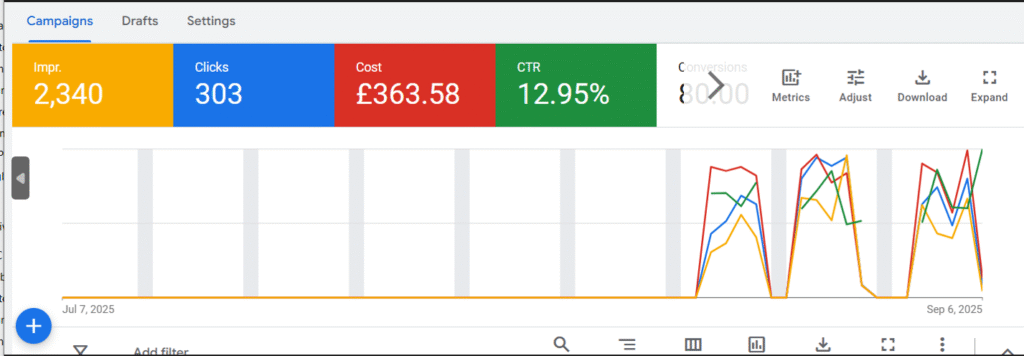
This campaign was built with a clear objective: generate qualified leads efficiently on a controlled budget. Here’s the performance breakdown:
- £363 total ad spend
- 2,340 impressions
- 303 clicks
- 12.95% click-through rate (CTR)
- 80+ conversions
- Approximately £4.53 cost per lead (CPL)
The campaign ran on the Search Network, targeting high-intent users actively looking for services. Instead of broad targeting, it focused primarily on exact match keywords to maintain control over relevance and spend.
Traffic was limited to a specific geographic area to ensure lead quality and reduce wasted impressions. Proper conversion tracking was installed from the start, allowing every form submission to be recorded accurately and optimization decisions to be based on real performance data.
No inflated metrics. Just structured execution and measurable results.
Strategy Breakdown: The Blueprint
A. Landing Page First (Not Website First)
One of the biggest decisions in this campaign was simple: do not send traffic to the main website.
Instead, all traffic was directed to a dedicated landing page built specifically for one goal lead generation.
The page had:
- Zero navigation (no menu, no external links, no distractions)
- A single CTA (one clear action: submit the form)
- Fast loading speed (under 2 seconds)
- A strong, clear value proposition above the fold
Every element on the page served one purpose: move the visitor toward submitting their details.
Why this matters:
A focused landing page significantly increases the conversion rate because it removes decision fatigue. When users have only one logical next step, more of them take it.
It also improves Quality Score, since the page experience aligns directly with the search intent and keyword targeting. Better Quality Score often leads to lower CPCs, meaning you pay less per click while maintaining visibility.
In short:
Better page experience → Higher conversions → Lower costs → More leads from the same budget.
B. Long-Tail + Phrase Match Domination
One of the biggest reasons small budgets disappear quickly is over-reliance on broad match keywords. Broad match casts a wide net, which sounds good in theory but in practice, it triggers ads for loosely related searches, low-intent queries, and irrelevant variations. With a £363 budget, that kind of leakage is expensive.
Instead of chasing volume, this campaign focused on long-tail keywords with clear commercial intent, using phrase match for tighter control while still capturing close variations.
The strategy centered on targeting high-intent modifiers such as:
- pricing
- quote
- near me
- book
- hire
- urgent
- consultation
Phrase match allowed the campaign to maintain structure and relevance while still benefiting from Google’s query expansion within controlled boundaries.
Example:
Bad:
marketing services
Better:
“digital marketing agency near me”
The difference is intent. The second search signals someone much closer to making a decision.
Bidding was structured around this intent level. Higher bids were allocated to keywords showing strong commercial signals, while lower-intent variations were either excluded or deprioritized.
Core principle:
Intent beats volume every time.
C. The Negative Keyword Framework
Before spending a single pound, a structured negative keyword list was built to protect the budget. With only £363 available, every irrelevant click would directly reduce lead volume. The goal wasn’t just traffic it was qualified intent.
The negative framework was divided into clear categories:
1. Job Seekers
Terms like: jobs, careers, salary, internship, hiring, CV
These users are looking for employment opportunities, not services. Blocking them immediately prevented wasted spend.
2. Researchers & Information Seekers
Terms like: definition, meaning, examples, course, tutorial, how to
These searches indicate curiosity or learning intent not purchasing intent. Removing them ensured ads only showed to buyers.
3. “Free” Traffic
Terms like: free, cheap, template, download, DIY
Users searching for free solutions rarely convert into paying leads. Filtering these queries protected cost efficiency.
4. Unrelated Locations
Excluding cities, countries, or regions outside the service area ensured that budget was spent only where services were actually available.
This structured negative filtering reduced irrelevant impressions, improved click quality, and increased overall relevance. That directly supported:
- Higher CTR
- Better Quality Score
- Lower CPC
- Stronger conversion rate
In a small-budget campaign, negative keywords are not optional they are budget protection.
By eliminating waste early, the £363 was spent only on users with genuine buying intent.
D. Conversion-Focused Ad Copy
Traffic alone doesn’t generate leads alignment does. The ad copy in this campaign was built around one principle: match the user’s intent as precisely as possible.
Keyword-to-Headline Alignment
Each primary keyword was reflected directly in the headline. If someone searched for a pricing-related term, the headline reinforced pricing. If they searched for a local service, the headline included the location. This tight alignment increased relevance and improved Quality Score.
Pricing Signals
Where appropriate, the ads referenced affordability, competitive pricing, or consultation offers. This pre-qualified users and filtered out low-intent clicks before they even landed on the page.
Urgency Triggers
Language such as “Book Today,” “Limited Slots,” or “Speak to an Expert Now” encouraged immediate action. High-intent users respond to clarity and direction not vague messaging.
Clear Call to Action (CTA)
Every ad ended with a direct, action-driven CTA:
Get a Quote. Book a Consultation. Request Pricing.
No ambiguity.
Responsive Search Ads (RSA) Testing
Multiple headline and description variations were tested inside Responsive Search Ads. This allowed Google to optimize combinations based on performance data while maintaining control over messaging structure.
The result of this structured copy approach was a 12.95% CTR, which indicates strong relevance between keyword, ad, and search intent.
High relevance attracts high-quality clicks. And high-quality clicks convert.
E. Tracking & Optimization System
The campaign didn’t succeed because it was launched well it succeeded because it was optimized consistently.
Conversion Tracking Setup
Before traffic was scaled, conversion tracking was properly configured to capture every lead submission. This ensured that optimization decisions were based on real performance data, not assumptions. Every form submission was tracked, verified, and attributed correctly.
Search Term Report Pruning
Search term reports were reviewed regularly to identify irrelevant queries. Any non-performing or low-intent variations were immediately added as negative keywords. This continuous pruning reduced waste and improved overall efficiency.
Bid Adjustments
Bids were adjusted based on performance signals. High-converting keywords received increased budget allocation, while underperforming terms were reduced or paused. This allowed the campaign to concentrate spend where returns were strongest.
Device Performance Analysis
Performance was segmented by device. If mobile users converted at a higher rate, budget allocation favored mobile traffic. If desktop underperformed, bids were adjusted accordingly. The campaign followed the data not assumptions.
Scaling What Works
Winning keywords were expanded with closely related variations. High-performing ad combinations were reinforced. Budget was shifted toward proven performers instead of evenly distributed across all assets.
Most importantly, optimization didn’t stop after launch. The campaign evolved based on measurable performance signals. Continuous refinement ensured that the £363 budget worked harder over time rather than fading after the first week.
Launch is only the starting point. Optimization is where profitability is built.
What Made This Work (Core Principles)
This campaign wasn’t driven by luck, budget size, or aggressive bidding. It worked because of disciplined execution and clear priorities.
Precision over volume
Instead of chasing thousands of impressions, the focus was on targeting people with strong buying intent. Every keyword, every click, and every pound had a purpose.
Structure over creativity
Creative ads are helpful but without the right structure, they fail. Tight keyword grouping, controlled match types, strong negative filtering, and a focused landing page created the foundation for performance.
Data over assumptions
No decisions were based on gut feeling. Search term reports, device data, CTR trends, and conversion rates guided optimization. If the data didn’t support it, it didn’t stay live.
Conversion psychology over traffic
The goal wasn’t to drive more visitors it was to drive the right visitors and guide them toward action. Clear messaging, urgency, pricing signals, and a single CTA reduced friction and increased conversions.
At its core, the philosophy is simple:
Small budgets don’t limit performance poor structure does.
Who This Strategy Works For
This approach isn’t limited to one industry. It works best where intent is clear, margins justify paid traffic, and the service solves an immediate problem.
Local Service Businesses
Plumbers, legal consultants, cleaning services, clinics, repair services — any business where users search with urgency and location intent. Searches like “emergency,” “near me,” or “pricing” signal immediate need, making structured Search campaigns highly effective.
B2B Consultative Offers
Agencies, consultants, marketing firms, IT providers, and financial advisors. When decision-makers search for solutions, they often include qualifiers like “pricing,” “proposal,” or “book consultation.” Targeting these terms captures high-value prospects.
Travel Agencies
Particularly those offering custom packages, visa assistance, or niche travel solutions. Users searching for specific routes, pricing, or booking assistance show strong commercial intent — ideal for controlled phrase match campaigns.
High-Intent Lead Generation Industries
Insurance brokers, mortgage advisors, medical services, home improvement companies — industries where users actively seek quotes and comparisons.
Businesses with Clear Service Pricing
If you can communicate value and pricing clearly, this structure works even better. Transparent offers filter serious buyers from casual browsers, improving conversion rates and lowering cost per lead.
The common factor across all of these?
Clear demand + measurable action + strong intent.
When those elements exist, a structured, intent-driven Google Ads strategy can generate consistent leads even on a limited budget.
Final Results Recap
Let’s bring it back to the numbers.
With a total ad spend of £363, the campaign generated 80+ qualified leads, achieving an average cost per lead of approximately £4.53. The ads maintained a strong 12.95% click-through rate, reflecting high relevance between keyword, ad copy, and user intent.
These weren’t vanity metrics. They were tracked, measured, and optimized conversions real inquiries generated through a structured Search campaign.
No inflated budget.
No broad targeting chaos.
No guesswork.
Just disciplined execution, intent-driven targeting, and continuous optimization.
Now, here’s how this same structured approach can be applied to your business.
How RankLoop Media Helps Businesses Generate Leads
At RankLoop Media, we apply this same structured, performance-first approach to every campaign we manage.
We specialize in:
- High-intent Google Ads campaigns built around commercial search behavior
- Cost-per-lead reduction strategies that eliminate waste and improve efficiency
- Conversion-focused landing pages designed to turn clicks into inquiries
- Data-driven optimization guided by real performance metrics
- Budget-efficient scaling that increases volume without sacrificing profitability
We don’t run ads for impressions.
We run ads for measurable acquisition.
Every campaign is built with tracking in place, structured match types, strong negative filtering, and continuous optimization. The focus is simple: generate qualified leads at a sustainable cost.
If you’re looking to improve your performance marketing results, you can:
- Book a strategy call
- Request a campaign audit
- Discuss your CPL goals
Because if you’re spending on ads but not seeing consistent leads,
the issue isn’t your budget it’s your strategy.
Frequently Asked Questions
1. Can you really generate leads with a small Google Ads budget?
Yes. If campaigns are structured around high-intent keywords, strict negative filtering, and optimized landing pages, small budgets can produce strong CPL performance.
2. What is a good cost per lead (CPL) in Google Ads?
It depends on the industry. In competitive markets, CPL can range widely. The key metric is profitability not just low cost.
3. Is phrase match better than broad match for lead generation?
For smaller budgets, phrase match or exact match usually provides better control and reduces wasted spend compared to broad match.
4. Why is conversion tracking important in Google Ads?
Without conversion tracking, optimization is guesswork. Proper tracking ensures budget is allocated toward keywords and ads that actually generate leads.
5. Should I send Google Ads traffic to my homepage?
In most cases, no. A dedicated landing page with one clear CTA typically converts better than a general homepage.